The 7-Step Sales Process: High-Impact Conversion Levers
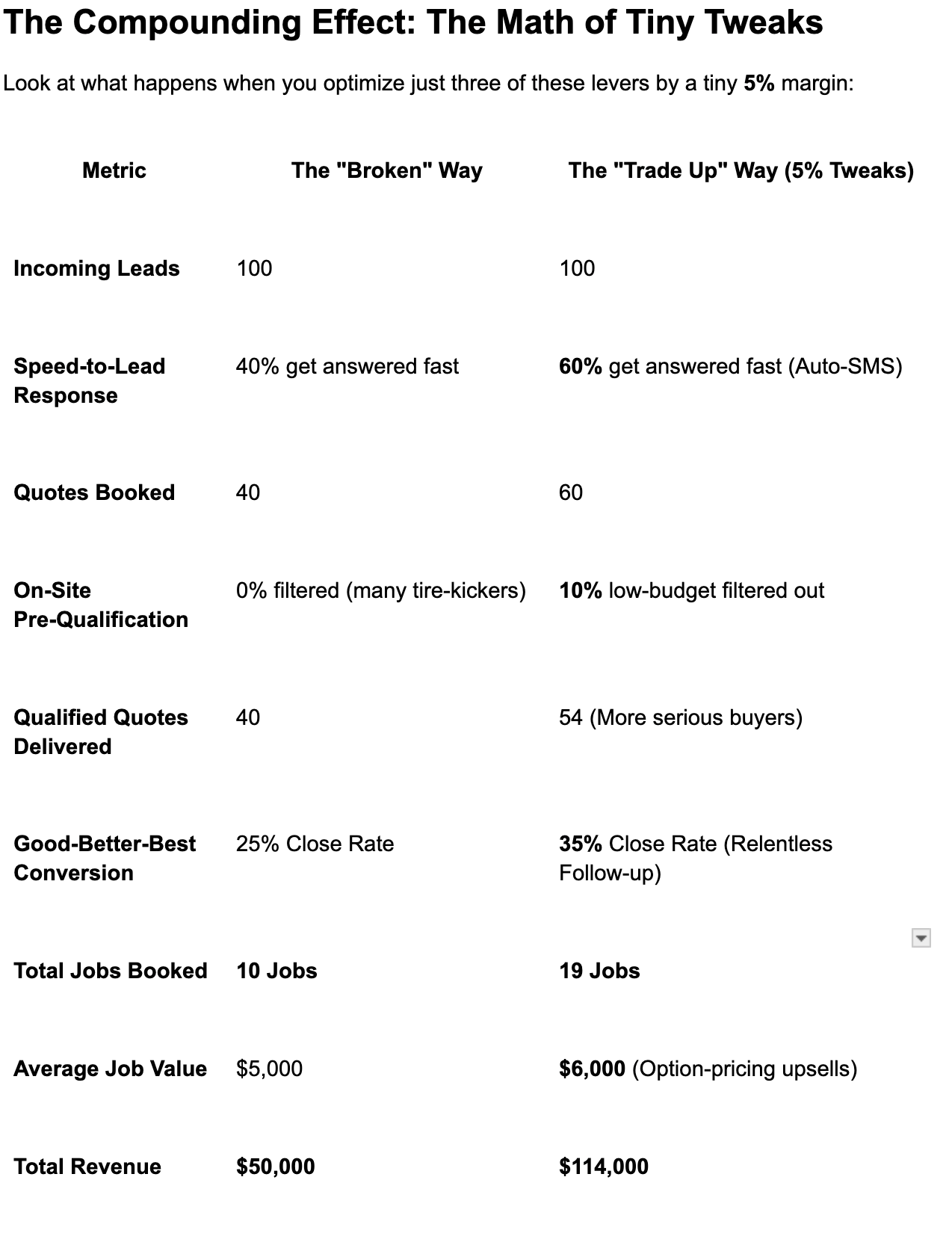
To turn a service business into a highly profitable system, you don't need to rebuild the entire company. You just need to pull a few specific "micro-levers" at each stage of your sales process.
Below is the exact blueprint of the 7-Step Sales Process, the common "leaks" at each step, and the small, automated adjustments that yield the biggest financial returns.
1. Capture ──> 2. Triage ──> 3. Assess ──> 4. Quote │ 7. Repeat <── 6. Collect <── 5. Nurture <─────┘
Step 1: Lead Capture (Speed-to-Lead)
This is the moment a customer reaches out via your website, Facebook, or Google Business Profile.
The Leak: Homeowners submit a quote request at 8 PM while sitting on the couch. Because you are at the dinner table or watching TV, you don't reply until 8 AM the next morning. By then, they’ve already booked with the competitor who replied in 5 minutes.
The Micro-Lever (Auto-SMS Text-Back): * The Fix: Set up an instant, automated text reply to any web form or missed call.
What it says: "Hey [First Name], got your request for the [service]! I'm actually on-site right now, but I want to make sure we look after you. Are you looking to get this done in the next 2 weeks, or are you just planning ahead?"
Why it works: It stops them from leaving your site to call the next contractor on Google. It initiates a conversation immediately on their phone, where response rates are 98%.
Step 2: The Triage (Pre-Qualification)
This is where you filter the serious buyers from the window-shoppers before you spend time driving.
The Leak: You drive 35 minutes to a house to estimate a deck, only to find out their budget is $2,000 and the job actually costs $12,000. You just wasted 2 hours of your life and $20 in gas.
The Micro-Lever (The "Two-Question" Photo Request):
The Fix: Before confirming a quote appointment, send an automated text asking for quick photos.
What it says: "Hey [Name], looking forward to seeing the property. To help me prepare the most accurate options for you before I arrive, could you text me 2 quick photos of the current area? Also, did you have a specific target budget you were trying to stay under for this project?"
Why it works: Tire-kickers won't text back photos. Serious buyers will. You filter out the price-shoppers instantly and gain massive context before you ever start your truck.
Step 3: The On-Site Assessment (Trust Building)
This is the physical visit to the customer's home.
The Leak: You show up unannounced, or 15 minutes late without warning, looking disorganized. The customer immediately starts looking for reasons to negotiate your price down.
The Micro-Lever (The "On-My-Way" Arrival Script):
The Fix: A single, automated text triggered from your phone when you are 15 minutes away, paired with a professional checklist on arrival.
What it says: "Hey [Name], this is Jackson from Trade Up. I’m leaving my last spot now and will be at your door in about 15 minutes. See you soon!"
Why it works: It shows high-end professionalism. When you arrive, present a simple, printed or tablet-based "Inspection Checklist." By standardizing your site visit, you make your eventually quoted price feel like a calculated science rather than a "guess."
Step 4: The Quote Delivery (AOV Escalation)
This is how you present your price to the customer.
The Leak: You email a single, flat price (e.g., "Deck: $8,500"). The customer's only choice is to accept the price, reject it, or ask for a discount.
The Micro-Lever (The "Good, Better, Best" Option Strategy):
The Fix: Never send a single price. Always present three choices in your digital quotes.
Option A (Budget): The bare minimum to get the job done.
Option B (Recommended): The job done right, with premium materials and a standard warranty (priced where you actually want it).
Option C (Premium): The ultimate package with lifetime warranty, faster timeline, and extra features.
Why it works: It shifts their psychological question from "Should I hire Jackson?" to "Which of Jackson's options fits my family best?" This simple change routinely increases Average Order Value (AOV) by 15% to 25% because human psychology naturally gravitates toward the middle and premium options.
Step 5: The Nurture Cadence (The Windshield recovery)
This is the follow-up process after you send the quote.
The Leak: You send a quote, they say "Let me talk to my spouse," and you never follow up because you feel awkward "chasing" them or you simply forget.
The Micro-Lever (The 3-Touch "Spouse-Friendly" Cadence):
The Fix: Let the CRM send a highly casual, personal-looking 3-part check-in.
Day 1 (Value): "Hey [Name], just wanted to make sure that quote didn't get buried in your inbox. Let me know if you and [Spouse's Name] had any questions about Option B!"
Day 4 (Urgency): "Hey [Name], our schedule for Niagara projects is filling up fast for next month. If you wanted to get this booked in, let me know so I can hold a slot for you."
Day 7 (The "Breakup" Text): "Hey [Name], I assume you've gone in a different direction or put this project on hold for now. I'll close out this quote on my end. If things change, feel free to reach back out!"
Why it works: The "Breakup Text" on Day 7 has the highest response rate of any sales text in history. People hate losing access to an offer and will reply instantly to explain why they haven't booked yet.
Step 6: Invoice & Deposit Collection (Cash-Flow Velocity)
This is how you secure the booking and collect final payment.
The Leak: You agree to a job, but you don't collect a deposit, or you accept paper checks. You end up chasing customers down at the end of the job, delaying your cash flow and wasting your evenings.
The Micro-Lever (Mobile Credit Card Deposit Links):
The Fix: The moment they click "Accept" on your "Good, Better, Best" quote, the platform automatically locks in the selection and text-messages them a secure payment link for a 10% or 25% scheduling deposit.
Why it works: They are most excited to buy at the moment they accept the quote. Securing the deposit instantly via credit card locks them in, eliminates buyer's remorse, and covers your material costs before you ever buy wood or load your tools.
Step 7: The Post-Job Loop (Reviews & Referrals)
This is how you turn a single invoice into permanent, free inbound traffic.
The Leak: You finish the job, shake their hand, and ask them to "please write us a review." They mean well, but they forget. You miss out on ranking higher on Google, meaning you have to keep paying for ads.
The Micro-Lever (The "Packing Up" Review Link):
The Fix: The exact second your tools are packed in the truck, mark the job as "Complete" in your app. This instantly triggers a text with a direct, one-click link to your Google Review page.
What it says: "Hey [Name], the crew is all packed up. We loved working on your home! Could you do us a massive 30-second favor? Tap this link and let Google know how we did so other Niagara families can find us: [Insert Review Link]"
Why it works: They are happiest with your work the moment the job is finished. Asking them via text while you are still in their driveway increases review conversion rates by 400% compared to emailing them a week later.